5 Ergonomic Artist Chairs For Your Studio
We may earn a commission for purchases made using our links. Please see our disclosure to learn more.
A good studio chair should support your body without limiting how you work. If you draw, paint, tattoo, sculpt, or spend long hours at a workbench, the right seat can make those sessions more comfortable. The best ergonomic artist chairs offer useful height adjustment, steady support, and enough freedom to move around your workspace. Here are five options worth considering for different studio setups.
What Makes an Artist Chair Ergonomic?
There isn’t one chair shape that works for every artist.
In fact, Cornell University’s guidance on the ergonomics of sitting points out that there is no single ideal sitting posture. A better approach is choosing seating that allows your body to use different comfortable positions.
For artists, adjustability becomes especially important because your working surface may be very different from a normal computer desk.
Look for features such as:
- Adjustable seat height
- Stable foot support
- A supportive seat pan
- A backrest or alternative torso support
- Easy swiveling
- Smooth casters
- Enough freedom for your arms and shoulders
The OSHA chair ergonomics guidelines also emphasize appropriate back support, adjustable seating, foot support, and a stable base.
Instead of trying to hold one “ideal” position all day, choose a chair that lets you shift and move comfortably as you work.
5 Best Ergonomic Artist Chairs for Your Studio
Different artists need different types of seating. A drafting chair may work well at a tall desk, while a saddle stool can be better for close-up work.
Quick Comparison
| Chair | Best For | Main Advantage |
| InkStool Ergonomic Artist Chair | Detailed creative work | Artist-focused support |
| Flash Furniture Harper Drafting Chair | Tall desks and drafting tables | Foot ring and back support |
| Boss B1615-BK Drafting Chair | General studio use | Simple, open design |
| Master Massage Berkeley Saddle Stool | Close-up work | Saddle-style seating |
| Office Star Work Smart Saddle Stool | Small studios | Compact and easy to move |

1. InkStool Ergonomic Artist Chair
The InkStool is made specifically for creative work. Its adjustable seat height makes it suitable for different studio surfaces, including drawing tables and workstations.
It also has padded supports that can help when you lean forward during detailed work.
Best for: Tattoo artists, illustrators, painters, and detail-focused work
Key features:
- Adjustable seat height
- Memory foam cushioning
- Adjustable upper-body support
- Five-caster base for easy movement
Keep in mind: It costs more than a basic drafting stool.
2. Flash Furniture Harper Drafting Chair
The Flash Furniture Harper is a practical choice if you work at a drafting table or taller desk.
It has a mesh back, padded seat, adjustable foot ring, and rolling base. The foot ring gives your feet a stable place to rest when the seat is raised above normal desk height.
Best for: Drawing, drafting, digital art, and tall workstations
Key features:
- Adjustable height
- Mesh backrest
- Built-in foot ring
- Swivel seat
- Rolling casters
Keep in mind: It may sit too high for a standard desk setup.
3. Boss Office Products B1615-BK Drafting Chair
This chair keeps things simple. It gives you adjustable height, a supportive backrest, a foot ring, and plenty of room around your arms.
The armless design can be useful for artists because it lets you move closer to your desk, easel, or work surface.
Best for: Sketching, drafting, painting, and general studio use
Key features:
- Adjustable seat height
- Supportive backrest
- Circular foot ring
- Armless design
- Swivel base with casters
Keep in mind: It has fewer adjustment options than more premium ergonomic chairs.
4. Master Massage Berkeley Saddle Stool
The Berkeley uses a saddle-shaped seat instead of a standard flat cushion. This seating style can help you sit closer to your work while keeping your hips in a more open position.
It also rolls easily, which is useful if you frequently move between tools or workstations.
Best for: Tattooing, sculpting, jewelry making, and detailed craft work
Key features:
- Saddle-shaped seat
- Adjustable height
- Thick cushioning
- Five-star rolling base
- Backrest options available
Keep in mind: Saddle stools can feel unusual at first.
5. Office Star Work Smart Saddle Stool
This is a good option if you want something compact and easy to move around the studio.
The padded saddle seat supports active sitting, while the swivel base makes it easy to turn between your work surface and nearby supplies.
Best for: Small studios, craft stations, classrooms, and mobile work
Key features:
- Adjustable seat height
- Padded saddle seat
- 360-degree swivel
- Rolling casters
- Compact design
Keep in mind: It offers less back support than a traditional ergonomic chair.
How to Choose the Right Ergonomic Artist Chair
Start with your actual working height.
Sit or stand where you normally create, then consider where your elbows need to be. Your chair should allow you to reach your work without repeatedly lifting your shoulders or bending your spine forward.
Next, think about how much you move.
A painter working between an easel and palette may appreciate casters and a swivel base. Someone doing precise illustration at a fixed drafting table may benefit more from a backrest and adjustable foot ring.
You should also pay attention to seat depth. A seat that extends too far behind your knees may encourage you to sit forward instead of using the backrest.
For more general chair-selection principles, this guide to choosing an ergonomic office chair explains how features such as lumbar support and adjustment affect everyday comfort.
Most importantly, don’t choose a chair based on the word “ergonomic” alone. Check its adjustment range against your height, body proportions, and work surface.
How to Set Up Your Artist Chair Properly
Even excellent ergonomic artist chairs can feel terrible when it is poorly adjusted.
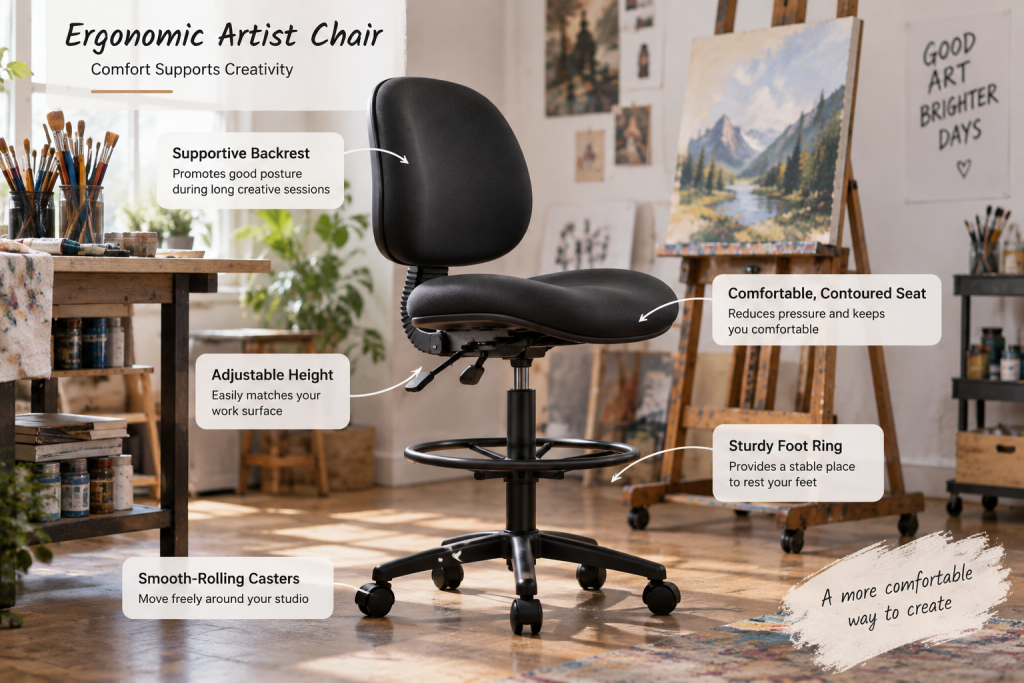
Start by changing the seat height so your working surface doesn’t force your shoulders upward. If your feet cannot reach the floor at that height, use the chair’s foot ring or a separate footrest.
Keep frequently used brushes, pencils, tools, and supplies close enough that you’re not repeatedly twisting or stretching.
And move.
No chair makes sitting motionless for hours ideal. OSHA specifically recommends changing working positions throughout the day, including standing and walking periodically.
Between longer creative sessions, try a few of these simple desk exercises and movement breaks. Even a short change of position gives your muscles a break from maintaining the same posture.
Conclusion
Choosing between ergonomic artist chairs comes down to how you work, not simply which chair has the most features. Drafting chairs are a practical fit for taller work surfaces, while saddle stools give you more freedom to move and get closer to detailed projects. Whatever style you choose, prioritize adjustable height, comfortable support, stable footing, and a seat that works naturally with your studio setup. A well-matched chair won’t replace regular movement and breaks, but it can make long creative sessions noticeably more comfortable and help you stay focused on the work instead of constantly adjusting your position.
FAQs
What is the best chair for an artist?
The best chair depends on your working surface and how you create. Drafting chairs suit tall tables, while saddle stools work well for artists who need mobility and frequently lean toward their work. Look for adjustable height, stable foot support, comfortable cushioning, and enough freedom to move.
Are saddle chairs good for artists?
They can be. Saddle chairs allow a more open hip position and make it easy to move close to your work. Tattoo artists, sculptors, jewelers, and detail-oriented artists may particularly appreciate them. However, saddle seating feels different from conventional seating and can take time to get used to.
Should an artist chair have armrests?
Not necessarily. Armrests may help during certain detailed tasks, but large fixed armrests can prevent you from getting close to a table or easel. Adjustable or removable armrests usually offer greater flexibility.
How high should an artist chair be?
There isn’t one correct height. Adjust the chair according to your work surface so you can work without constantly shrugging your shoulders or bending excessively forward. If the chair needs to sit high, make sure your feet have stable support.
Are drafting chairs good ergonomic artist chairs?
Yes, particularly when you use drafting tables, standing-height desks, or elevated workbenches. Look for a model with adjustable height, a supportive backrest, a stable five-point base, and an adjustable foot ring.