Top 10 Best Ergonomic Loupes
We may earn a commission for purchases made using our links. Please see our disclosure to learn more.
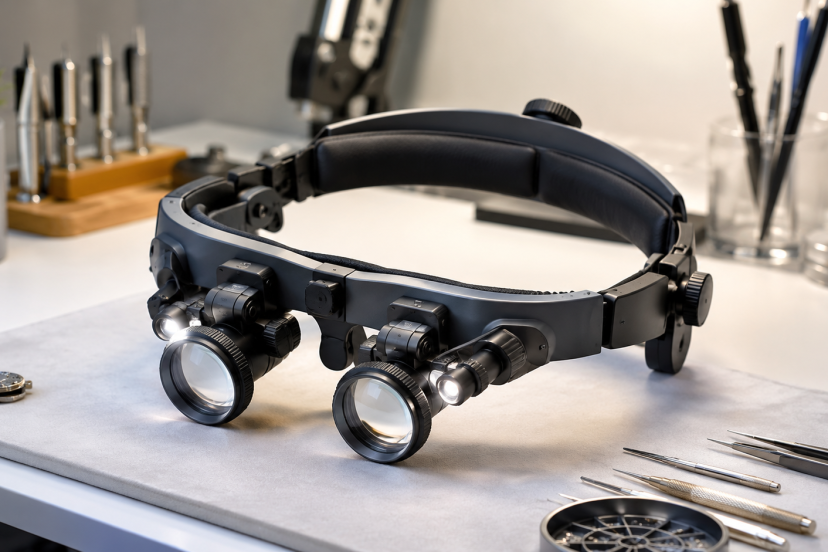
Detailed work has a sneaky way of pulling your head forward. You begin with decent posture, then suddenly your nose is six inches from a circuit board and your shoulders are somewhere near your ears. The best ergonomic loupes help you see small details without constantly leaning, squinting, or holding a magnifier in one hand. This guide compares ten highly rated options available through Amazon US for jewelry work, electronics repair, miniature painting, sewing, model building, inspection, and other precision tasks.
Research suggests correctly selected magnification can improve working posture, although fit, working distance, declination angle, and user adaptation all matter. Recent dental studies have found lower postural risk when clinicians use magnification rather than working without it.
Our Top Picks
| Product | Best For | Key Feature | Rating | Read More |
| YOCTOSUN LED Head Magnifier | Best overall | Interchangeable frame and headband | ★★★★⯨ | Read more |
| Donegan DA-5 OptiVISOR | Optical clarity | Precision glass lenses | ★★★★⯨ | Read more |
| Carson CP-60 MagniVisor Deluxe | Illuminated visor | Four lenses and adjustable light | ★★★★⯨ | Read more |
| Vision Aid Expert Edition | Eyeglass wearers | Comfortable headset-style design | ★★★★⯨ | Read more |
| GUOUBUO Magnifier Headset | Lightweight comfort | Four lenses up to 5X | ★★★★⯨ | Read more |
| YOCTOSUN 4-LED Magnifier | Bright lighting | Four adjustable LEDs | ★★★★⯨ | Read more |
| Dilzekui Headband Magnifier | Magnification range | Six lenses with up to 14X combined power | ★★★★⯨ | Read more |
| Beileshi Headhand Magnifier | Budget buyers | Five interchangeable lenses | ★★★★⯨ | Read more |
| Headband Magnifier | Crafts and needlework | Stable headband and five lenses | ★★★★⯨ | Read more |
| JARLINK 30X/60X Loupe | Portable inspections | Folding dual-lens design | ★★★★⯨ | Read more |
Best Ergonomic Loupes Reviewed
1. YOCTOSUN LED Head Magnifier
Best for: Most users
Rating: ★★★★⯨

The YOCTOSUN earns our best-overall spot because it balances comfort, versatility, lighting, and value unusually well. Its five lenses provide 1X, 1.5X, 2X, 2.5X, and 3.5X magnification, covering everything from sewing to close electronics inspection.
You can wear it like glasses or replace the arms with the included head strap. That flexibility matters when the nose bridge begins feeling uncomfortable during a long session. The rechargeable two-level LED light also eliminates disposable batteries.
Amazon-derived market data showed more than 16,000 customer ratings and strong ongoing sales at the time of research.
Pros
- Five easy-to-change lenses
- Rechargeable adjustable light
- Eyeglass-style and headband configurations
- Strong value for occasional and regular use
Cons
- Front weight may bother sensitive users
- Plastic lens holder requires careful handling
2. Donegan DA-5 OptiVISOR
Best for: Optical clarity and professional workshops
Rating: ★★★★⯨

The Donegan DA-5 is the old-school workhorse of this group—in a good way. Instead of loading the headset with electronics, Donegan focuses on clear, precision-ground glass lenses and a dependable adjustable headband.
The DA-5 supplies 2.5X magnification at an eight-inch focal length. It fits over many prescription and safety glasses and flips upward when you need normal vision. Donegan also offers interchangeable lens plates with different focal lengths and magnification levels.
Pros
- High-quality optical glass
- Comfortable padded headband
- Useful working distance
- Replaceable lens plates
Cons
- No built-in light
- Heavier and costlier than basic acrylic models
3. Carson CP-60 MagniVisor Deluxe
Best for: A traditional visor with integrated lighting
Rating: ★★★★⯨
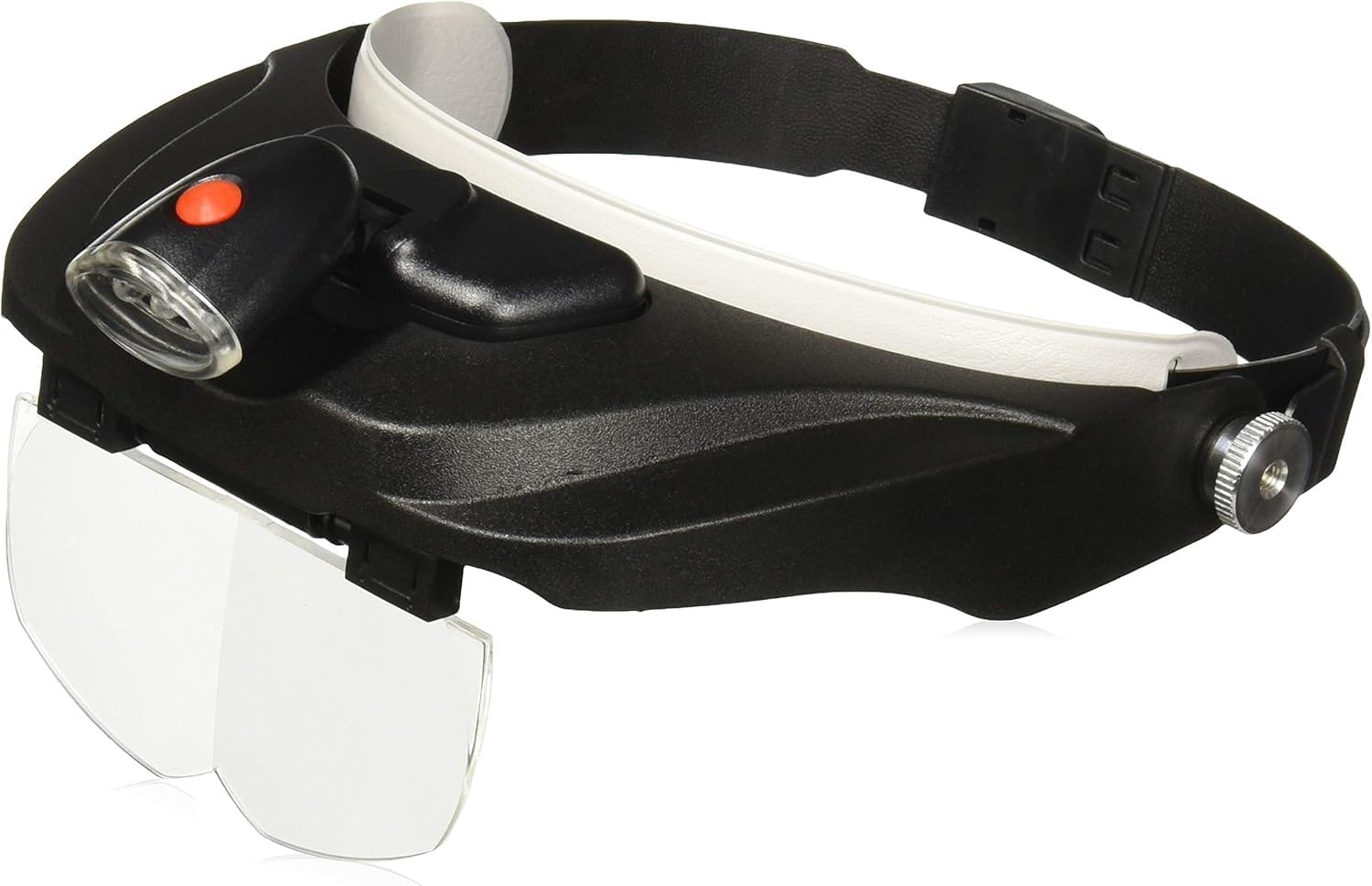
The Carson CP-60 provides the stability of a full headband while adding an adjustable LED lamp. It includes four lenses covering 1.5X, 2X, 2.5X, and 3X magnification, making it useful for model building, watch repair, carving, and fly tying.
The broad visor distributes pressure more evenly than glasses-style magnifiers. Its lamp can also pivot independently, although it requires three AAA batteries rather than USB charging. The model had more than 4,000 customer ratings when checked.
Pros
- Four interchangeable lenses
- Adjustable light direction
- Secure fit for larger heads
- Lens flips away when not needed
Cons
- Batteries are not included
- Bulkier than glasses-style alternatives
4. Vision Aid Expert Edition
Best for: Users who wear prescription glasses
Rating: ★★★★⯨

Vision Aid’s Expert Edition is a sensible choice when you need clearance around your existing glasses. It combines an adjustable head-mounted design, rechargeable LED lighting, interchangeable lenses, and a storage case.
The balanced headset is especially practical for miniature painting and detailed hobby work where you frequently look away from the task. At the time of research, it carried more than 2,000 Amazon customer ratings.
Pros
- Works well over many eyeglasses
- Rechargeable lighting
- Protective storage case
- Wide range of applications
Cons
- Takes time to adjust correctly
- Higher magnification shortens working distance
5. GUOUBUO Magnifier Headset
Best for: Lightweight wearable magnification
Rating: ★★★★⯨

The GUOUBUO headset uses four detachable lenses offering 1.5X, 2.5X, 3.5X, and 5X magnification. Its glasses-style frame feels less helmet-like than a full visor, making it convenient for shorter repair or craft sessions.
The rechargeable light tilts toward the work area, while adjustable temple arms help reduce squeezing around the head. The tradeoff is that the 5X lens has a very short focal distance, so it works better for inspection than prolonged tool work.
Pros
- Relatively lightweight
- Adjustable temple arms
- Rechargeable directional light
- Useful 5X inspection lens
Cons
- Limited room at maximum magnification
- Less stable than a full headband
6. YOCTOSUN 4-LED Head Magnifier
Best for: Working in dim rooms
Rating: ★★★★⯨

This YOCTOSUN model upgrades the illumination with four LEDs and multiple brightness options. You still receive five lenses from 1X through 3.5X, but the broader lighting makes shadows less distracting when stitching, soldering, or painting miniatures.
It had approximately 2,400 Amazon ratings when researched, giving it a more established feedback history than many newer competitors.
Pros
- Four bright LEDs
- Five magnification choices
- Rechargeable power
- Includes a stabilizing headband
Cons
- More front-heavy than unlit visors
- Similar lenses can be easy to mix up
7. Dilzekui Headband Magnifier
Best for: A broad magnification range
Rating: ★★★★⯨

The Dilzekui includes six lenses that can be combined for magnification from 1X to 14X. That range is useful when your work alternates between assembly and extremely close inspection.
Its rechargeable lamp and adjustable full headband provide a secure fit, although the additional components make it heavier than minimalist eyewear-style models. The product had more than 2,500 ratings during our research.
Pros
- Six included lenses
- Very high combined magnification
- Bright rechargeable light
- Secure adjustable headband
Cons
- Heavier than most alternatives
- Maximum power provides little tool clearance
8. Beileshi Headhand Magnifier
Best for: Budget-conscious beginners
Rating: ★★★★⯨
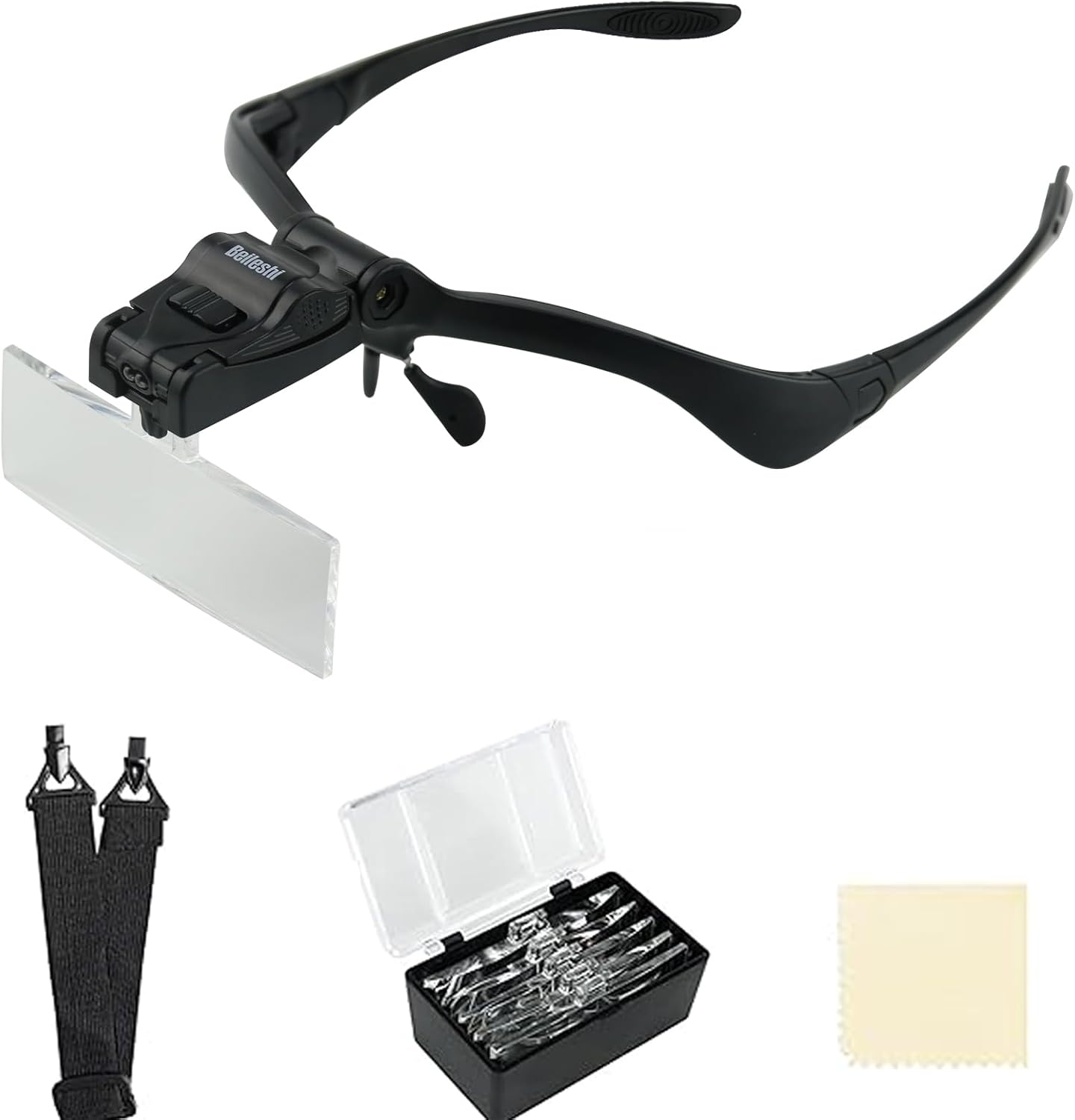
The Beileshi gives beginners the familiar five-lens, dual-LED format without excessive complexity. It can switch between glasses arms and a head strap, allowing you to experiment with both wearing styles.
Its lightweight construction is comfortable, but the plastic frame is not intended for workshop abuse. With more than 2,000 customer ratings, it remains a well-established entry-level choice.
Pros
- Affordable and lightweight
- Five interchangeable lenses
- Two wearing configurations
- Integrated LEDs
Cons
- Lightweight frame feels less durable
- Nose support may require adjustment
9. Headband Magnifier
Best for: Needlework, painting, and crafts
Rating: ★★★★⯨

Dicfeos includes five lenses from 1X to 3.5X, a built-in light, removable arms, and an elastic headband. The lower powers provide enough working distance for crochet, cross-stitch, and painting without forcing your hands against your face.
The lighting could be stronger, but the straightforward design and large review history make it a practical craft-room option.
Pros
- Comfortable lower magnification options
- Suitable for numerous crafts
- Interchangeable arms and strap
- Easy lens changes
Cons
- Light is relatively modest
- Weight remains concentrated near the forehead
10. JARLINK 30X/60X Jewelers Loupe
Best for: Coins, gemstones, stamps, and quick inspections
Rating: ★★★★⯨

The JARLINK is not a hands-free headset. Instead, it is a compact folding loupe designed for brief, extremely close inspection. Its 30X and 60X lenses each have dedicated LED illumination, making hallmarks, edges, solder joints, and surface defects easier to examine.
It has one of the largest feedback histories in this roundup, with nearly 30,000 customer ratings when researched.
Pros
- Highly portable folding design
- Two powerful lenses
- Built-in LED and UV lighting
- Excellent for brief inspections
Cons
- Not hands-free
- Tiny focal area is unsuitable for long sessions
How to Choose the Best Ergonomic Loupes
Start With Working Distance
Working distance is the space between the lens and your task when the image appears sharp. A longer distance gives your hands more room and can help you sit upright. Extremely powerful magnification usually shortens that space.
For most crafts and bench work, start between 1.5X and 2.5X. Move higher only when the detail genuinely requires it.
Consider Weight Distribution
A light product can still become uncomfortable when all its weight rests on your nose. Headbands generally distribute pressure better, while glasses-style frames are less bulky.
For additional fitting principles, read the complete guide to ergonomic loupes.
Do Not Overlook Lighting
Magnification also magnifies your lighting problems. Adjustable illumination reduces shadows and may help you avoid tilting your head toward the work. This ergonomic lighting guide explains how brightness, glare, direction, and color temperature affect visual comfort.
Treat Clinical Loupes Differently
Dentists, hygienists, and surgeons should prioritize measured working distance, declination angle, prescription compatibility, pupillary distance, field depth, and professional adjustment. A poorly fitted loupe can simply replace one awkward posture with another.
Final Thoughts
The best ergonomic loupes should let you see clearly without turning your neck into a question mark. The YOCTOSUN LED Head Magnifier is our best overall recommendation because it offers flexible magnification, rechargeable lighting, two wearing styles, and strong customer feedback. Choose the Donegan DA-5 when optical clarity and durability matter most, or the Carson CP-60 when you prefer a stable illuminated visor. Whichever model you select, prioritize comfortable working distance and balanced fit over maximum magnification—that is where the real ergonomic benefit begins.
Frequently Asked Questions
What magnification is best for ergonomic loupes?
Around 2X to 2.5X is a comfortable starting point for many crafts and general precision tasks. It enlarges details while preserving a useful field of view and reasonable working distance.
Can ergonomic loupes prevent neck pain?
They may encourage a more upright posture, but they cannot guarantee pain prevention. Correct working distance, fit, lighting, seating, task height, and regular movement remain important. Research findings are promising but not completely uniform.
Can I wear a head magnifier over prescription glasses?
Full headband models such as the Donegan OptiVISOR generally provide the most clearance. Some glasses-style products can also be converted to a strap configuration and worn over regular eyewear.
Is higher magnification always better?
No. Higher power reduces depth of field, narrows your viewing area, and brings the task closer to your face. Use the lowest power that clearly reveals the required detail.
Are these loupes suitable for professional dentistry?
General-purpose magnifiers can help with training, hobbies, or nonclinical inspection, but they are not substitutes for professionally fitted dental loupes. Clinical users should consult a specialist who can measure their eyes, posture, and working distance.